
Policy, Co-Stewardship & Governance: Who Gets to Shape Alaska's Future?

One of the recurring themes throughout the Regenerative Outdoor Visioning Project has been that many of the outcomes we experience—whether related to community wellbeing, conservation, economic opportunity, infrastructure, recreation, or stewardship—are ultimately shaped by decisions made long before a trail is built, a permit is issued, or a visitor arrives.
That made this conversation on Policy, Co-Stewardship & Governance feel like a particularly important stop along the journey.
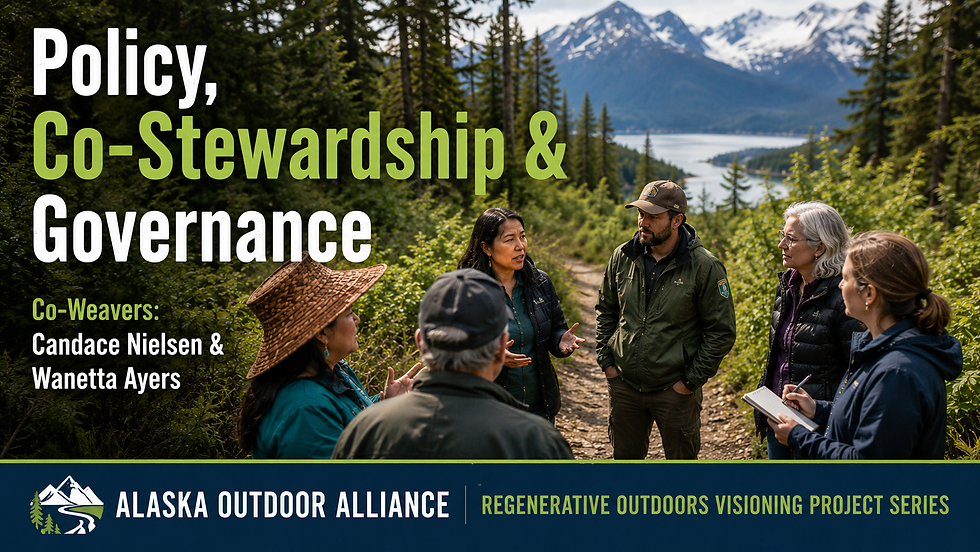
Our co-weavers, Candace Nielsen of The Aleut Corporation and former Mayor of Cold Bay, and Wanetta Ayers of the Southwest Alaska Municipal Conference, helped us explore the systems, assumptions, and decision-making structures that influence Alaska's future. Their perspectives came from different places, but often converged around a common theme: the people most affected by decisions are not always the people shaping them.
Decisions Made For Communities Instead of With Them
Candace reflected on growing up and serving in Cold Bay, a community of roughly 45 people, and the challenge of helping policymakers understand the realities of life in places far from Alaska's road system. She described how remote communities are often viewed through a lens of cost, scarcity, or decline rather than as places rich with knowledge, resilience, ingenuity, and cultural expertise.
One observation resonated throughout the session: decisions are too often made for communities rather than with them. Participants noted that communities frequently find themselves reacting to outside proposals rather than helping shape them from the beginning. The importance of trust-building, showing up, and creating meaningful opportunities for participation emerged repeatedly.
Several participants also challenged the assumption that remote places are "empty" or "untapped." As one chat participant observed, many of these communities are older than both the State of Alaska and the United States itself. Others noted that landscapes often described as wilderness are also places with deep histories, relationships, and cultural meaning.
The Alaska Conundrum
Wanetta introduced what she called the "Alaska conundrum." Many of Alaska's most significant economic opportunities—whether related to fisheries, tourism, energy, or natural resources—exist in rural Alaska. Yet much of the state's political power resides in urban Alaska. That disconnect, she argued, helps explain why some of Alaska's most important conversations seem perpetually stuck.
She also discussed the concept of the resource curse: the tendency for resource-rich places to become overly dependent on extraction while underinvesting in the things that make communities healthy and resilient. Education, quality of life, local capacity, and community wellbeing often struggle to compete with larger economic forces.
One intriguing idea was the concept of rural proofing, an approach used in parts of Europe that asks a simple question of every policy and public investment: How will this land in rural communities? Participants wondered whether Alaska needs its own version of that test.
Planning, Funding, and the Reactive Trap
A recurring frustration involved the relationship between planning and funding. Participants noted that planning is often required to qualify for funding, yet funding for planning itself is frequently unavailable. Communities with the least capacity are often expected to produce plans, navigate complex grant systems, and respond to emerging opportunities or crises with limited staff and resources.
As a result, communities can become trapped in reactive modes of operation—responding to disasters, funding opportunities, or large development proposals rather than proactively shaping their futures. Several participants observed that meaningful community engagement takes time, trust, and multiple communication channels, yet those activities are rarely funded.
One participant captured the dilemma succinctly:
Planning is often a threshold for funding. But planning itself is rarely funded.
Writing a Constitution for Regenerative Outdoor Futures
The breakout exercise asked participants to imagine they were drafting a constitution for regenerative outdoor futures in Alaska. While each group approached the challenge differently, several principles appeared repeatedly:
Local control and community self-determination
Respect for local and Indigenous knowledge
Sovereignty and meaningful representation
Forward-thinking decision-making rather than crisis response
Bringing the right people to the table early
Shared language and clear communication
Long-term commitments to community wellbeing
Stewardship and accountability
Decisions made closest to the people and places affected by them
Economic activity serving community and ecological wellbeing rather than the other way around
Participants also challenged the tendency to assume that hub communities automatically represent surrounding villages and regions, noting that meaningful engagement often requires going further, listening longer, and meeting people where they are.
Measuring What Matters
Perhaps the strongest bridge to the project's upcoming Metrics & Measuring What Matters session emerged around the question of value. Several participants argued that many of today's metrics are designed to measure economic activity rather than ecological health, community wellbeing, cultural vitality, or stewardship. GDP, for example, may be able to measure the value of lumber produced from a forest but struggles to capture the value of an intact forest supporting wildlife, cultural practices, carbon storage, recreation, and community identity.
The conversation raised an important question: What if success was measured not only by what we extract, build, or sell—but by the health of relationships, ecosystems, communities, and future opportunities we leave behind? That question actually will continue into our final session on June 16.
A Working Definition Emerging
While participants did not arrive at a single definition of regenerative governance, a common thread emerged.
A regenerative governance system would likely place greater value on relationships before projects, local knowledge before assumptions, stewardship before extraction, and long-term wellbeing before short-term gains. It would create space for communities to help shape decisions rather than simply respond to them. And it would seek measures of success that reflect the health of people, places, and ecosystems together.
If the purpose of this project is to imagine what more regenerative outdoor futures might look like, this conversation suggested that the answer may begin not with new projects, but with new ways of making decisions.



Comments